Every team sheet comes with a string of numbers: 4-4-2, 4-3-3, 3-5-2. Commentators throw them around as if everyone knows what they mean. Here’s the good news: once you know the one simple rule behind them, you can read any formation in seconds.
This guide explains how formations are written, then walks through the four shapes you’ll see most often, with a diagram of each, plus what each one is good and bad at.
How to read the numbers
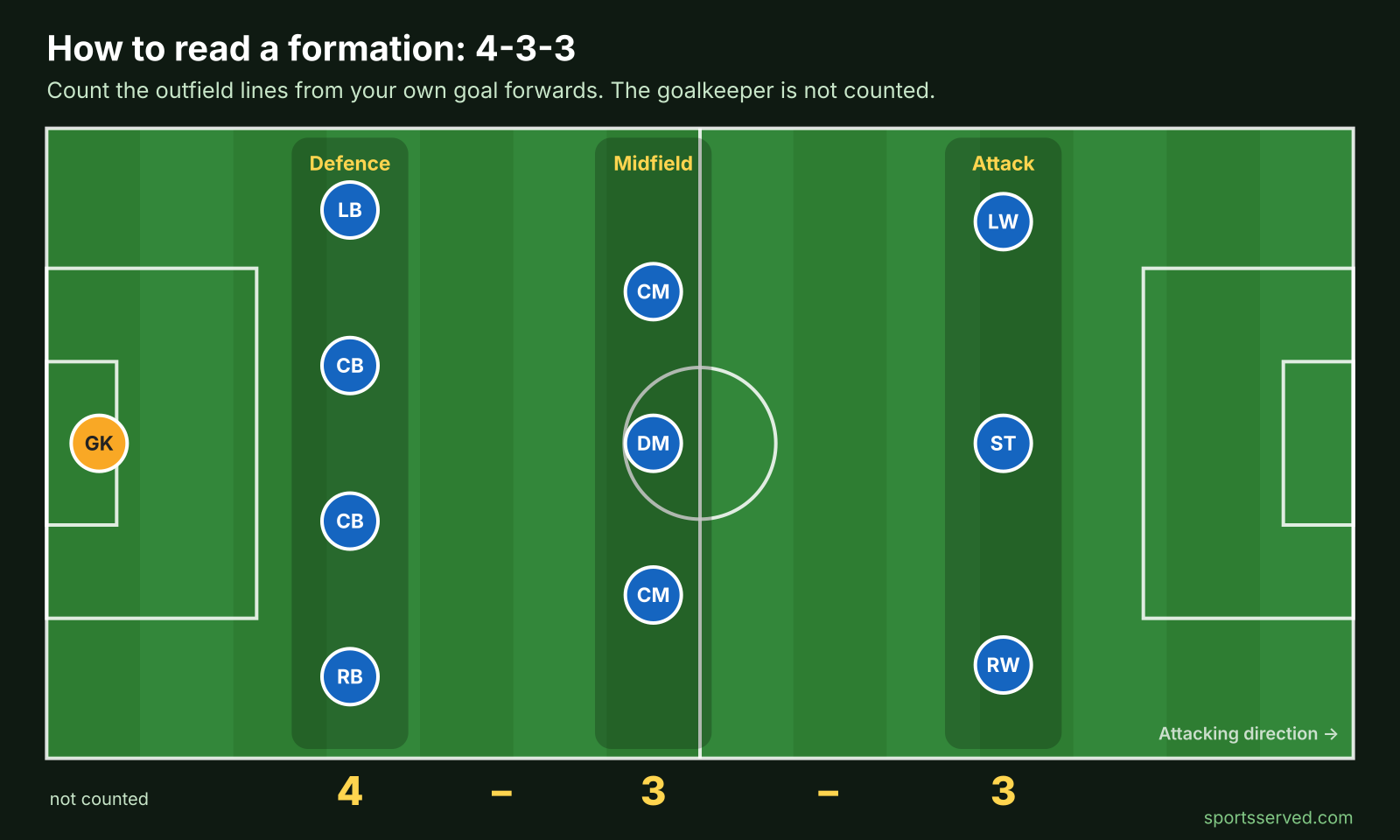
A formation lists how many outfield players stand in each line, from defence to attack. The goalkeeper is never counted, so the numbers always add up to 10.
Take 4-3-3:
- 4 defenders
- 3 midfielders
- 3 forwards
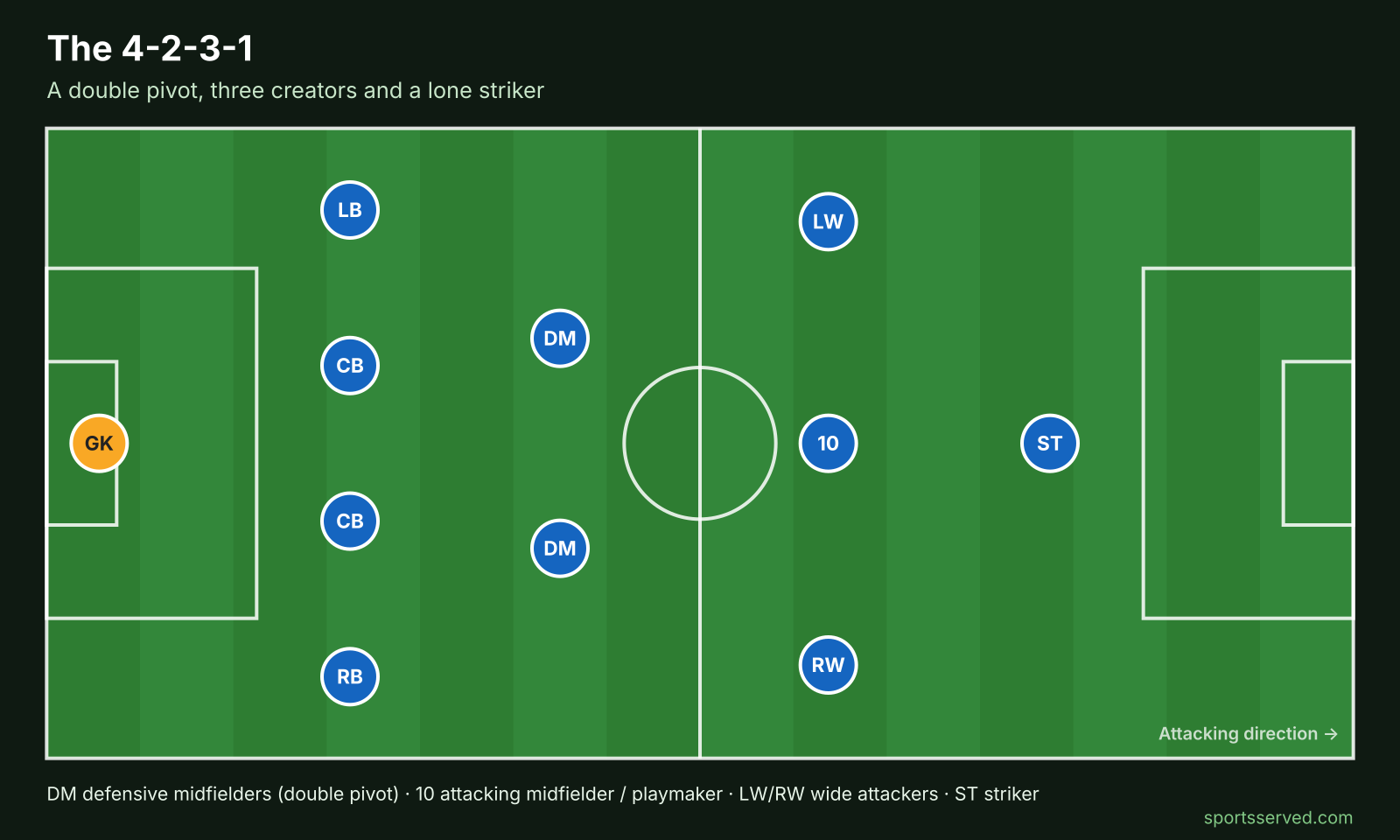
Some formations use four numbers, like 4-2-3-1. That just splits the midfield into two layers: two players sitting deeper and three playing further forward behind a lone striker.
4-4-2: the classic
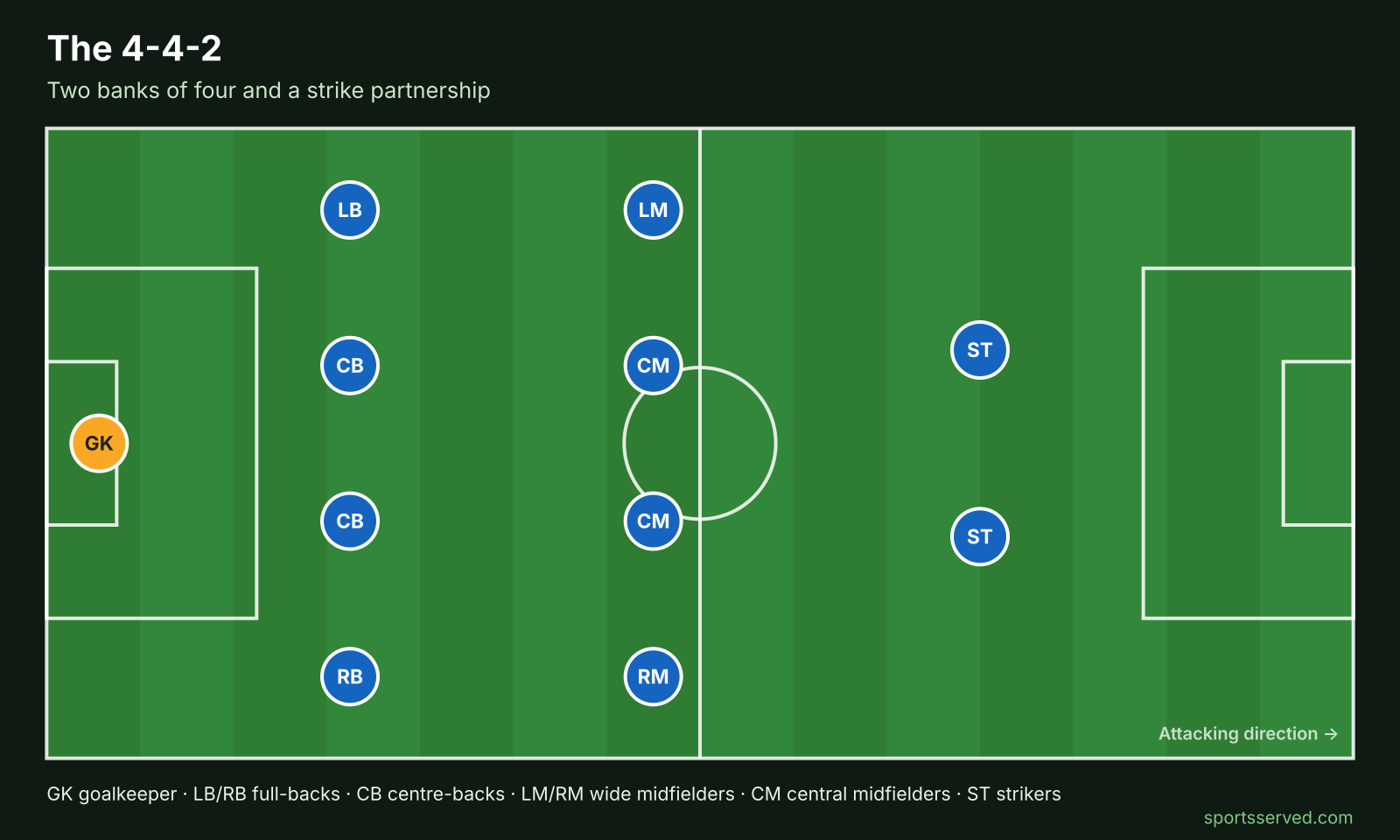
Four defenders, four midfielders in a flat line, two strikers. For decades it was the default shape in English football, and it is still the easiest formation to understand.
Strengths
- Two strikers can work as a pair: one big target man and one quick runner is the classic partnership.
- Two banks of four make a compact, hard-to-break defensive block.
- Every player has a clear partner and a clear job.
Weaknesses
- With only two central midfielders, a team playing three in midfield can outnumber them and dominate the ball.
- It leaves gaps between the lines that a clever number 10 can exploit.
Famous example: Leicester City won the 2015/16 Premier League with a disciplined 4-4-2 built on fast counter-attacks.
4-3-3: control and width
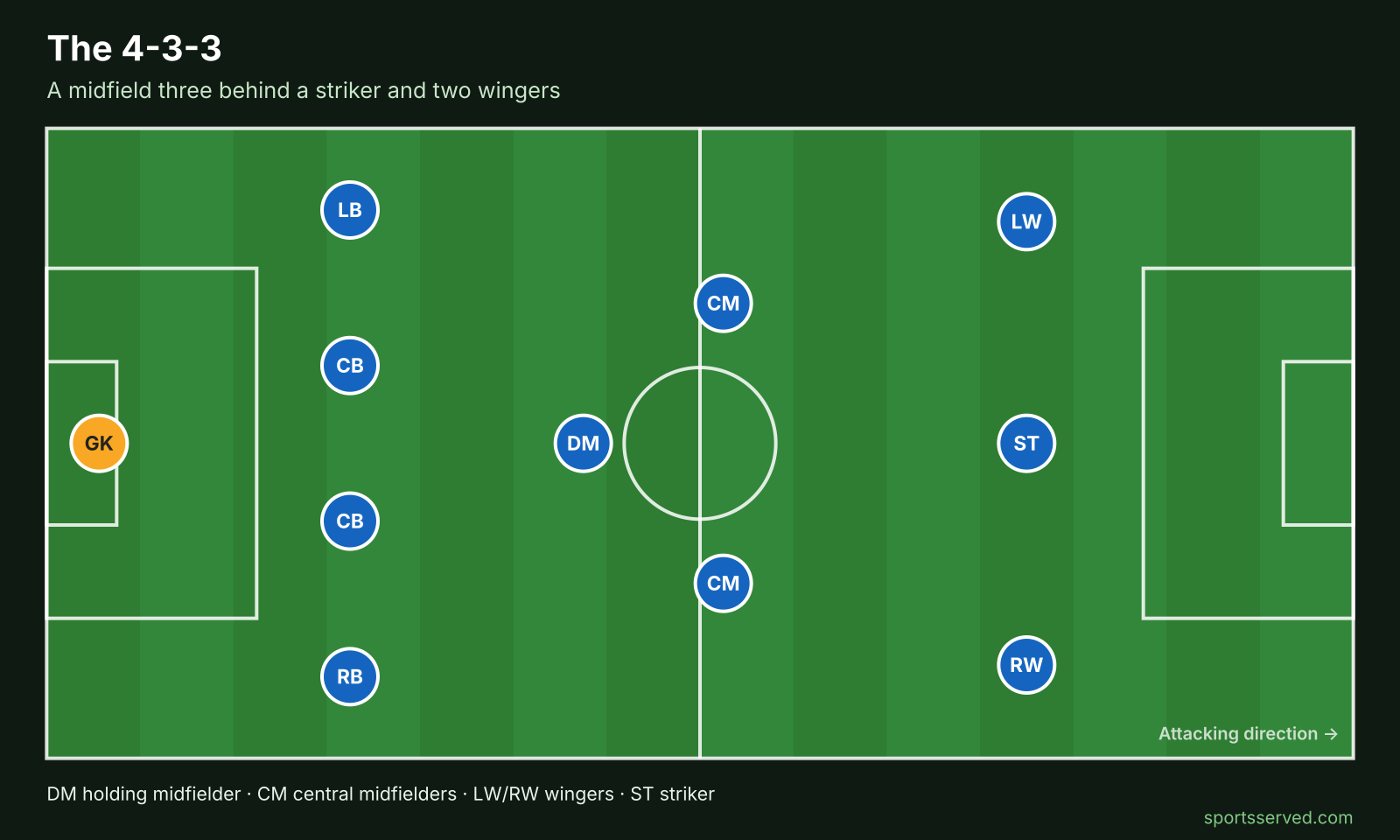
Four defenders, three central midfielders and three forwards: a central striker with a winger on each side. It is one of the most common shapes in modern top-level football.
Strengths
- Three central midfielders help a team keep the ball and win the battle in the middle.
- Wingers stretch the pitch, creating space for midfielders and full-backs to run into.
- Three forwards can press high and win the ball back near the opponents’ goal.
Weaknesses
- If the wingers don’t track back, the full-backs can be left two-against-one.
- It relies on a disciplined holding midfielder; if that player is bypassed, the defence is exposed.
Famous example: Pep Guardiola’s Barcelona (2008–12) made the possession-based 4-3-3 world-famous.
4-2-3-1: balance in layers
Four defenders, two defensive midfielders (often called a “double pivot”), three attacking midfielders and one striker. The middle of the three behind the striker is the classic number 10, the team’s creative playmaker.
Strengths
- Two holding midfielders give the back four extra protection.
- The number 10 operates in the space between the opponents’ midfield and defence, where they are hardest to mark.
- It switches easily into a 4-4-1-1 when defending, with the wide players dropping back.
Weaknesses
- The lone striker can become isolated if the attacking midfielders don’t get forward.
- It can feel cautious: with two deep midfielders, fewer players commit to attack.
3-5-2: three at the back and wing-backs
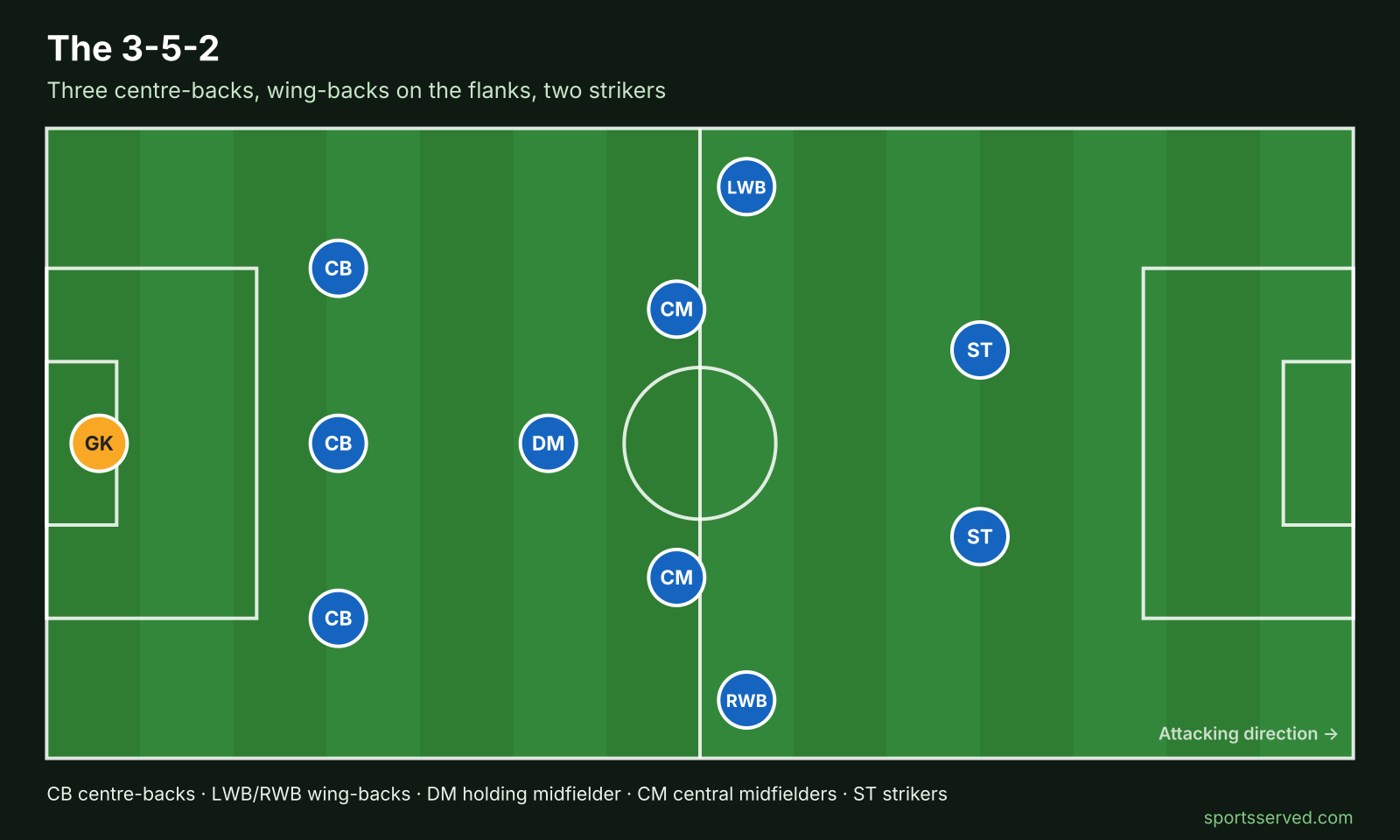
Three centre-backs, five midfielders and two strikers. The key players are the two wing-backs: the wide players in the midfield five who cover the whole flank, defending like full-backs and attacking like wingers.
Strengths
- Three centre-backs give cover against two strikers, with one always spare.
- Five midfielders make it hard to be outnumbered in the middle.
- When defending, the wing-backs drop back and the shape becomes a solid 5-3-2.
Weaknesses
- Wing-backs need huge stamina. If they’re caught upfield, the space behind them is wide open.
- Against a team with good wingers, the three centre-backs can be pulled out of position.
Variations: 3-4-3 swaps one central midfielder for a third forward. Antonio Conte’s Chelsea won the 2016/17 Premier League after switching to a back three mid-season.
The four formations at a glance
| Formation | Defenders | Midfield | Forwards | Best for | Main risk |
|---|---|---|---|---|---|
| 4-4-2 | 4 | 4 (flat) | 2 | Compact defending, quick counters | Outnumbered in central midfield |
| 4-3-3 | 4 | 3 | 3 | Possession and high pressing | Full-backs exposed if wingers don’t track back |
| 4-2-3-1 | 4 | 2 + 3 | 1 | Balance and a free playmaker | Isolated lone striker |
| 3-5-2 | 3 | 5 (incl. wing-backs) | 2 | Midfield control, solid back line | Space behind the wing-backs |
Formations change during the game
The formation on the team sheet is a starting point, not a fixed grid. Most teams have one shape with the ball and another without it.
- Out of possession: a 4-3-3 often becomes a 4-5-1 as the wingers drop back into midfield. A 3-5-2 becomes a 5-3-2 as the wing-backs join the defence.
- In possession: full-backs push high, a midfielder drops between the centre-backs, and a back four can turn into a back three to build from the back.
So when a commentator says a team is “playing 4-3-3”, think of it as the shape they start from and return to, not where every player stands all match.
FAQ
Why isn’t the goalkeeper included in the formation?
Because every team has exactly one, always in the same place. The numbers only describe the 10 outfield players.
What is the most common formation today?
There is no single answer, but 4-3-3 and 4-2-3-1 are among the most widely used at the top level, with back-three systems also common.
What is the best formation?
There isn’t one. The best formation is the one that suits a team’s players and the opponent they’re facing.
What is a false 9?
A centre-forward who drops deep into midfield instead of staying up front, pulling defenders out of position and leaving space for others to run into.
What’s the difference between a full-back and a wing-back?
A full-back is a defender in a back four. A wing-back plays further forward in a back-three system and is expected to cover the whole flank.
What does a formation like 4-1-4-1 mean?
Same rule: four defenders, one holding midfielder, a line of four midfielders and one striker.