
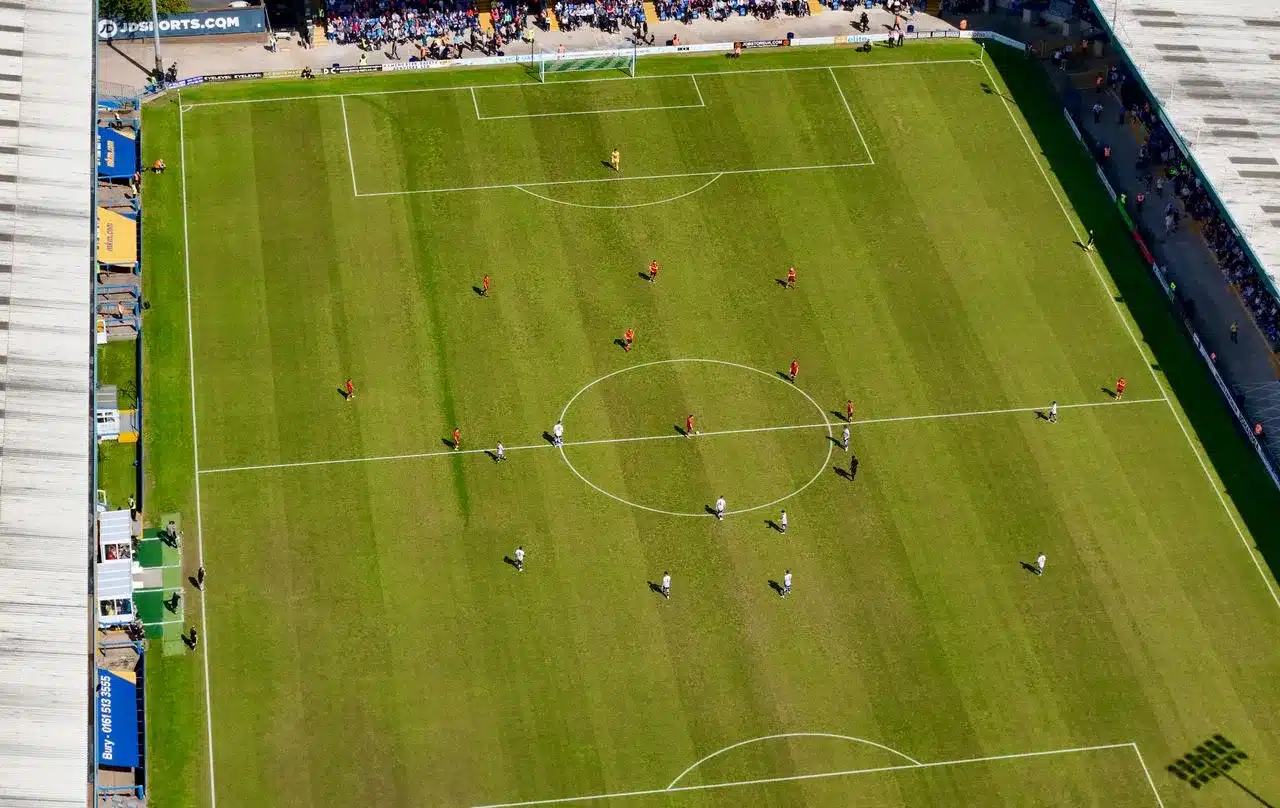
Offside is the rule that starts more arguments in pubs, group chats and TV studios than any other in football. Yet the core idea fits in one sentence: an attacker can’t simply hang around behind the defence waiting for the ball.
This guide explains the offside rule step by step, with diagrams. You’ll learn when a player is in an offside position, when that actually becomes an offence, the situations where offside never applies, and the myths even seasoned fans still believe. It follows Law 11 of the official IFAB Laws of the Game.
What is an offside position?
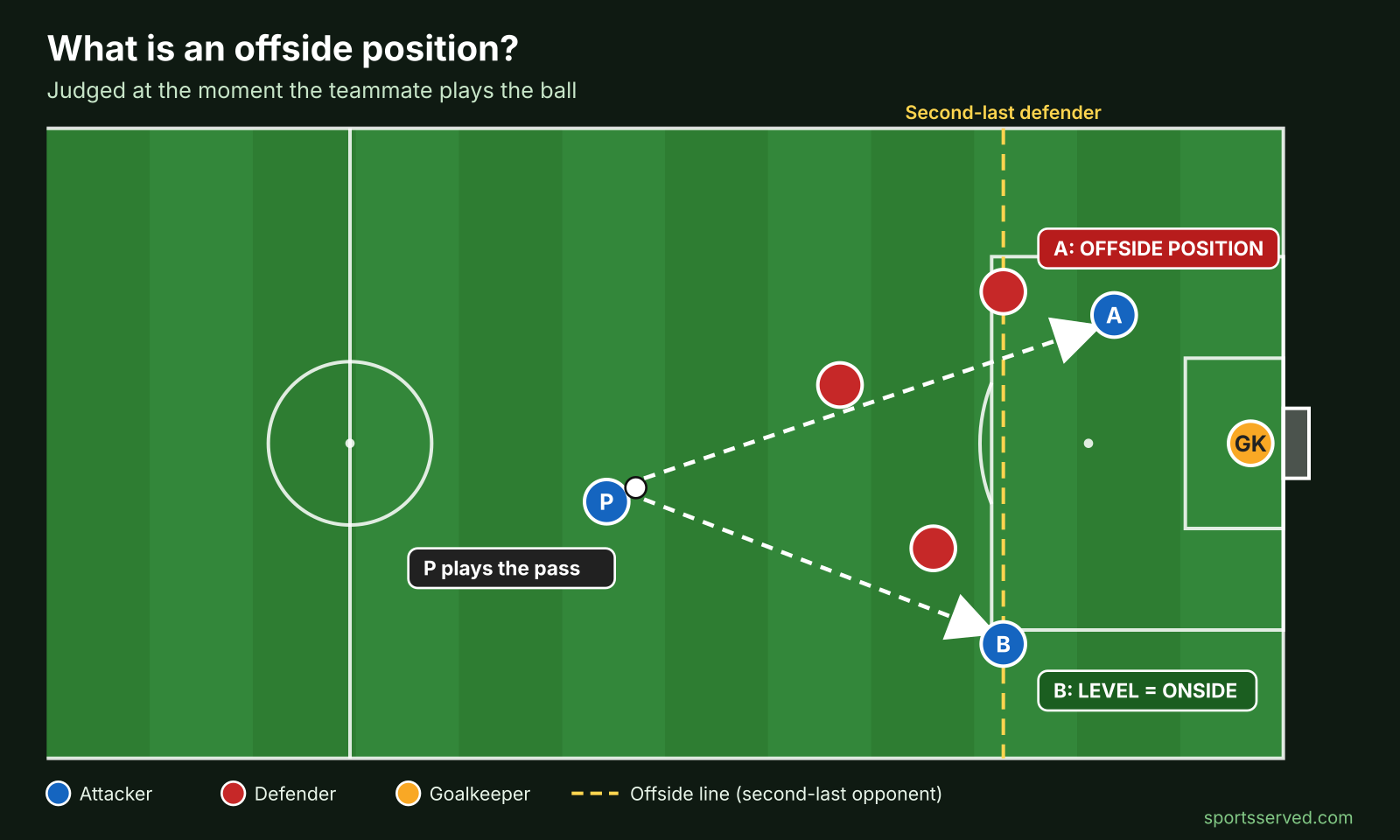
A player is in an offside position if, at the moment a teammate plays or touches the ball, all three of these are true:
- They are in the opponents’ half (the halfway line itself counts as their own half).
- They are nearer to the opponents’ goal line than the ball.
- They are nearer to the opponents’ goal line than the second-last opponent.
The “second-last opponent” is usually the last outfield defender, because the goalkeeper is normally the last one. But it doesn’t have to be: if the goalkeeper has rushed out, two outfield defenders may be the last two players, and the second of those is the line that counts.
Level is onside. A player who is exactly level with the second-last opponent, or level with the last two opponents, is not in an offside position.
Which body parts count?
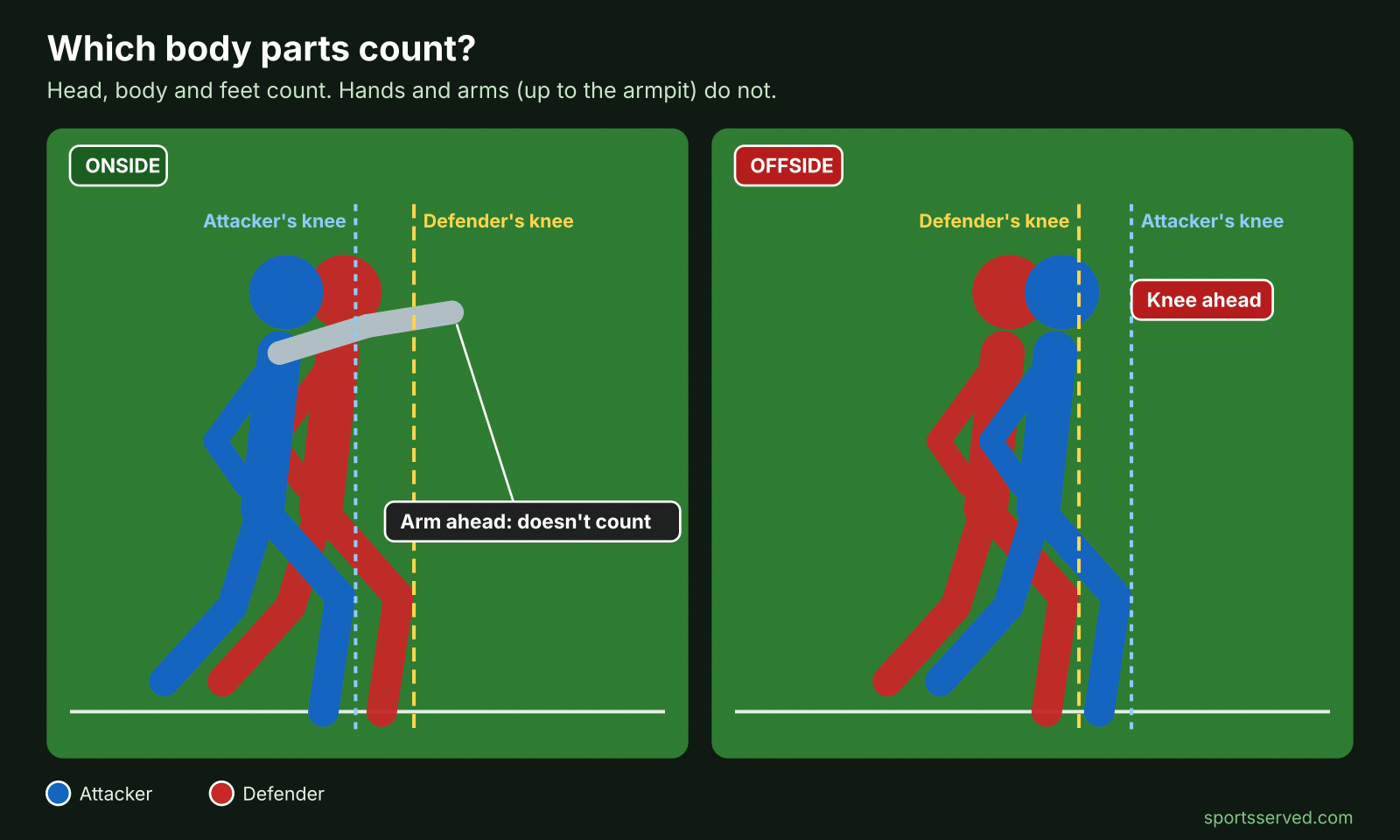
Offside is judged on any part of the body a player can legally score with: head, body and feet. Hands and arms don’t count, for attackers, defenders or goalkeepers. The upper limit of the arm is the bottom of the armpit, so a shoulder that pokes past the defender can make a player offside, but an outstretched arm can’t.
That is why VAR decisions sometimes come down to a knee, a toe or a shoulder. The relevant point is whichever legal body part is closest to the goal line, for both the attacker and the defender.
Being in an offside position is not an offence
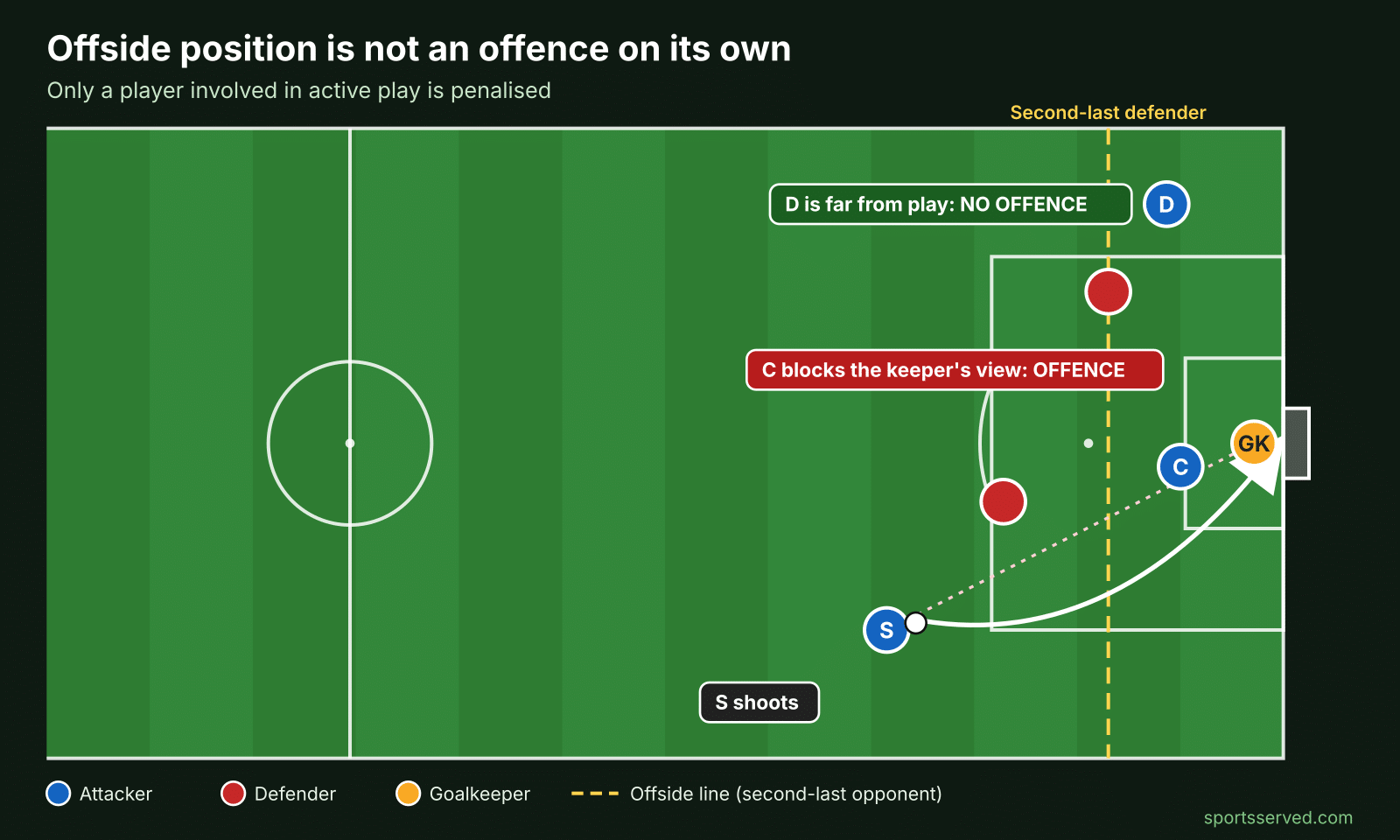
This is the part most people miss. Standing in an offside position is perfectly legal. A player is only penalised if they become involved in active play. There are three ways that can happen:
- Interfering with play: playing or touching the ball passed or touched by a teammate.
- Interfering with an opponent: for example blocking the goalkeeper’s line of sight, challenging an opponent for the ball, clearly attempting to play a ball that is close to them, or making an obvious action that affects an opponent’s ability to play the ball.
- Gaining an advantage from that position: playing a ball that rebounds or is deflected to them off the post, crossbar, a match official or an opponent, or that comes off a deliberate save by an opponent.
So a striker in an offside position on the far side of the pitch, nowhere near the ball, is not committing an offence when a teammate scores. The flag should stay down.
The “deliberate play” exception. If a defender deliberately plays the ball (a controlled pass, clearance or header, not a save), an attacker who was in an offside position is not penalised for receiving it. A deliberate save, on the other hand, does not reset anything.
The punishment: an indirect free kick to the defending team, taken from where the offence happened.
When you can’t be offside
There are four situations where offside simply doesn’t apply:
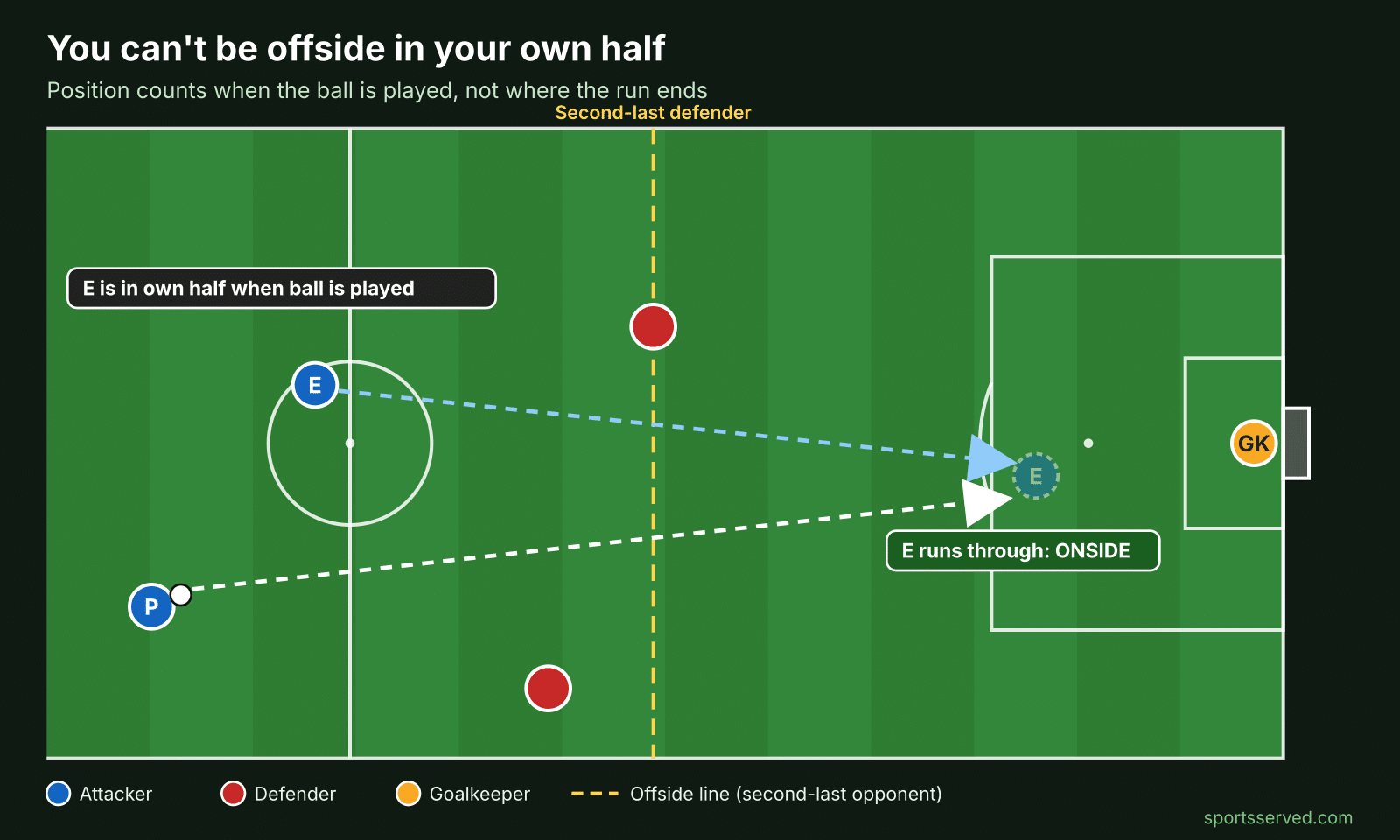
- In your own half. A player standing in their own half when the ball is played can’t be offside, however far they sprint afterwards.
- Directly from a goal kick.
- Directly from a throw-in.
- Directly from a corner kick.
Note the word “directly”. Once another player touches the ball after the throw-in, corner or goal kick, offside applies again as normal.
One more detail: when a goalkeeper throws the ball, the moment used to judge offside is the last point of contact with the ball. This was clarified in the 2025/26 Laws of the Game.
Five offside myths
| Myth | Reality |
|---|---|
| “He was offside when he received the ball.” | Offside is judged when the teammate plays the ball, not when it arrives. |
| “You need two defenders between you and the goal.” | You need two opponents, and one of them is usually the goalkeeper. In practice the line is the last outfield defender. |
| “Being in an offside position is a foul.” | It’s only an offence if the player becomes involved in active play. |
| “You can’t be offside if the ball comes off a defender.” | Only a deliberate play by a defender resets offside. A deflection or a save does not. |
| “The arm counts if it’s ahead.” | Hands and arms are ignored for every player, goalkeepers included. |
How VAR and technology judge offside
The rule itself is the same with or without VAR. What has changed is how precisely it is measured.
- The assistant referee (linesman) watches the second-last defender’s line and raises the flag. In close calls, assistants are often told to keep the flag down until the move ends, so VAR can check it afterwards.
- VAR freezes the frame at the moment the ball is played and draws lines from the relevant body parts of the attacker and the second-last defender.
- Semi-automated offside technology (SAOT) uses tracking cameras, and in some competitions a sensor in the ball, to find the kick point and players’ limb positions automatically. The decision is then shown as a 3D animation.
This precision is why fans now see goals ruled out by a few centimetres, and why the debate about changing the rule has grown louder.
Could the rule change? The “daylight” trial
Arsène Wenger, FIFA’s Chief of Global Football Development, has long pushed for a “daylight” version of offside. Under it, an attacker would only be offside if there is a clear gap between them and the second-last defender. If any scoring body part is still level, the attacker would be onside.
IFAB approved a trial of the idea in the Canadian Premier League for its 2026 season. The results go to IFAB after the season, and a worldwide change would be possible from 2027/28 at the earliest. Critics argue the change would hand too much advantage to attackers.
Until IFAB decides otherwise, the rule explained in this guide is the one used everywhere outside the trial.
FAQ
Can a goalkeeper be offside?
Yes, in theory. The rule applies to every player, but it almost never happens because the keeper is rarely beyond the ball in the opponents’ half.
Can you be offside from a throw-in?
No. Offside does not apply directly from a throw-in, a corner kick or a goal kick.
Can you be offside in your own half?
No. A player must be in the opponents’ half to be in an offside position. The halfway line counts as your own half.
Is it offside if you’re level with the defender?
No. Level with the second-last opponent, or with the last two opponents, is onside.
Does a backward pass make it onside?
Yes. If the player is behind the ball when it is played, they can’t be offside, even if they are beyond the defenders.
What happens after an offside offence?
The defending team gets an indirect free kick from the spot where the offence took place.
Why was the offside rule introduced?
To stop “goal hanging”, where attackers wait near the opponents’ goal for a long ball. It forces teams to build attacks rather than just launch the ball forward.